Entry 5: Midterm Progress Report
What I did this week (Feb 9, 2021 - Feb 14, 2021) (and so far)
Up to this point, my focus has been on making a prototype of my room in Unity in order to have an application to test and work with all of the things I needed to learn to actually make my capstone. This started with modelling for scale in 3D, and the workflow of porting assets into Unity, and developed into an interactive environment with triggered animations, a video that can be played, and 3D sound, all of which will appear again in my capstone. Furthermore, the development of this re-attuned my sense of what the time frame looks like on this kind of project. 3D modelling takes a very long time, and scripting and building in Unity takes quite a while too, if you don’t know know what you’re doing, which I didn’t. However, halfway through making my room, I realized my time probably would have been better spent making some sort of religious building, considering I’m making one now. This is when I got the idea to have rooms and other worlds and geometries colliding with my cathedral, thus creating links between the memories and the physical space. This idea also allows me to use my room assets as a bedroom that may trigger some memory. So now, I need to use all the principles I employed in my room in the cathedral, put it all together, and we’ll be done… for now. This process has been slow moving, but most of the hard tutorial work I needed to figure out was in interfacing with Unity and scripting in C#. Now, most of those scripts are capable of being used again, since first person movement is always first person movement, and interactive objects were written in such a way that the script can easily be modified to fit into any interactive object in the game world. So, in essence, it is all recyclable.
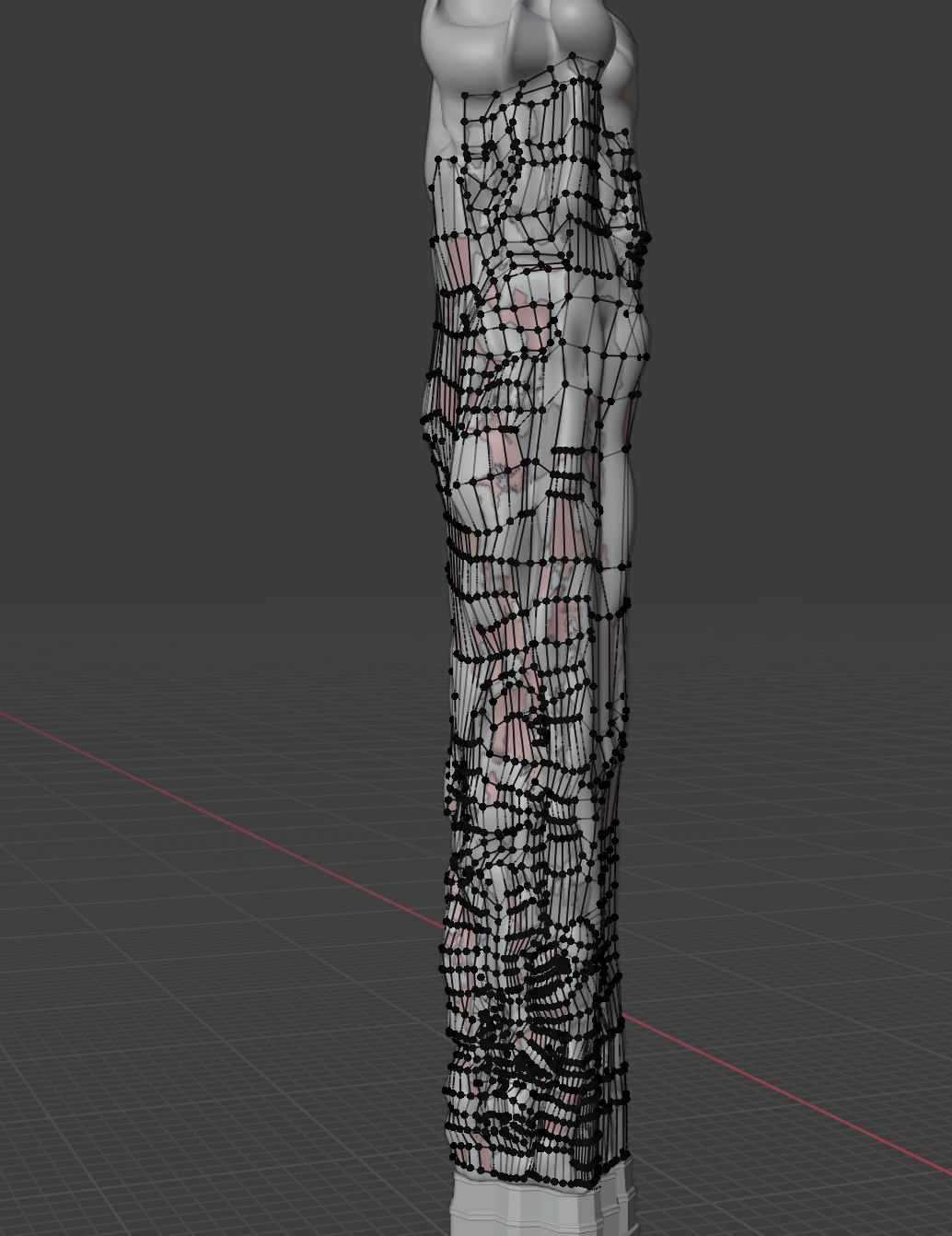
Retopology in action
This week I focused on getting started on the real cathedral: sussing out what my architectural “style” will be, along with getting started on the modelling of the place. I first determined what the size should be. Assuming that Blender’s units are around 1m to 1u, I took the measurements of the Cologne Cathedral in Germany (which was chosen simply for being a famous example of Gothic architecture, and applied it to the floor plane and walls. Then, I took the pews from a previous cathedral I built and imported them in to the save the time that would be taken making all new ones, and then proceeded to get started on the pillars that will line the sides of the building. I decided to approach them from an angle of clashing organic and geometric forms, using the Blob brush in Blender’s sculpting tools to make the pillars reminiscent of candle wax that has melted, dripped, and re-solidified. This, of course, requires you to subdivide the mesh a lot, and so a re-topology is required to reduce the mesh back down, and then bake the details that were lost into a displacement or normal map. This process allows very high resolution, complicated meshes to translate easily into game engines. The pillar I made, however, was overly complicated and took nearly a day and a half to retopologize, even with the help of a useful Blender addon: SpeedRetopo. I will discuss what I will be approaching going forward with these in the next section, but long story short, the mesh took forever to retopologize and still might be too complicated for Unity
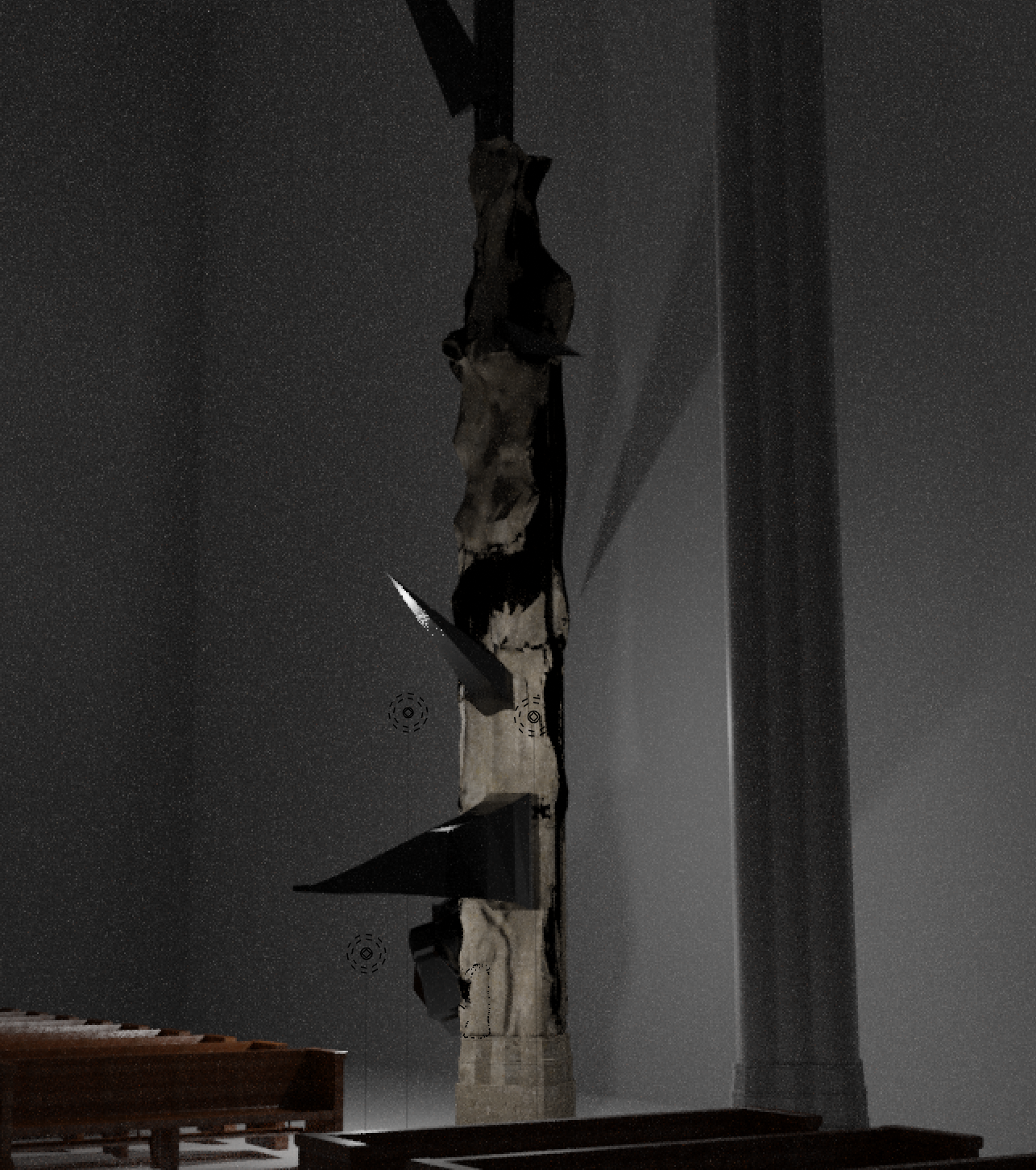
The first finished pillar
Contexts
Since this work features a lot of different disciplines (3D Modelling, Game Design, Sound Design, and Writing), my inspirations are across the artistic board. Early on, I was looking to filmmakers like Frederico Fellini and Andrei Tarkovsky who create works that are surreal and emotionally heavy with religious symbolism, or the lack thereof. This spawned a lot of my thinking surrounding the project.
Then, I focused on artists who use exhibition space to create worlds, and VR work, which is emerging, as a guide on how to immerse an audience member in a world both physically and digitally. In this area I looked primarily to Olafur Eliasson, and the game Half Life Alyx which presents the most real and immersive digital world I’ve ever seen. It should be mentioned that while I am not intending on making my work VR this quarter, my BFA capstone does intend on adapting this work to that medium, so that’s where my head is at.
When it comes to sound, and I have not mentioned this much in previous blog posts, mostly focusing on music in those, I imagine the soundscapes taking the form of works by Pauline Oliveros or Hildegard Westerkamp, but with voice over laying on top.
The writing is heavily inspired by Bill Callahan, formerly known as Smog, whose songs are written in this beautiful way which alludes to different professions and life experiences without putting a finger right down on them, and focusing on human moments within those experiences, like a song about a prison guard reveling in taking the prisoners to a lake and watching them swim, as the only moment of freedom for them. This sort of dwelling in a moment and experiencing it is exactly what I want the voice overs to describe in real and imagined scenarios.
Schedule
Week 6 - Model the cathedral as much as possible
Week 7 - Continue modelling the cathedral hoping to be done by the end of this week, write audio clips
Week 8 - Record and edit audio clips, move assets from blender into unity
Week 9 - Piece all of the assets together and make them interactive in Unity
Week 10 - Final playtesting and bug fixes, along with spillover time if something takes longer than expected