Entry 3: The Prototype Room
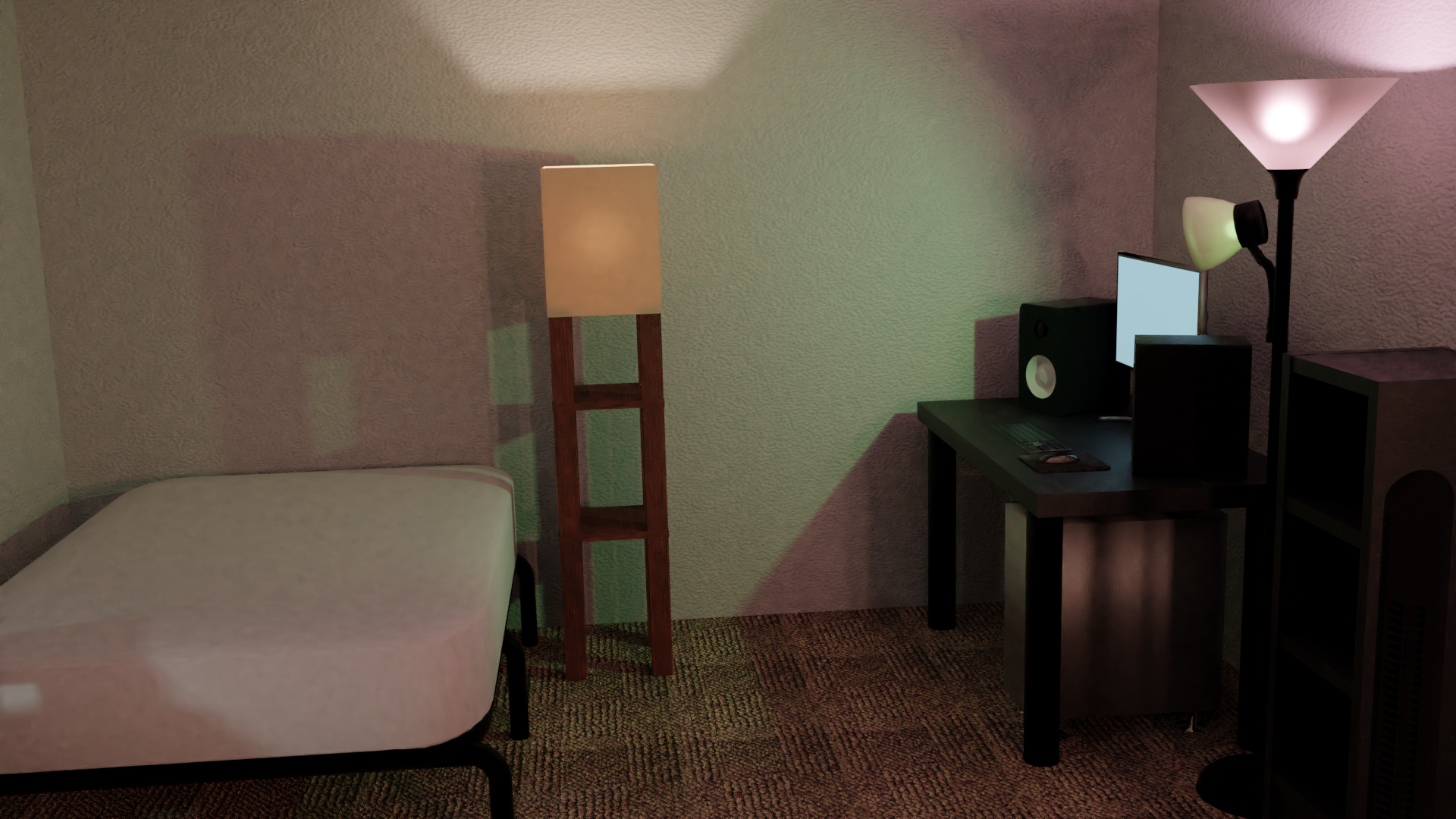
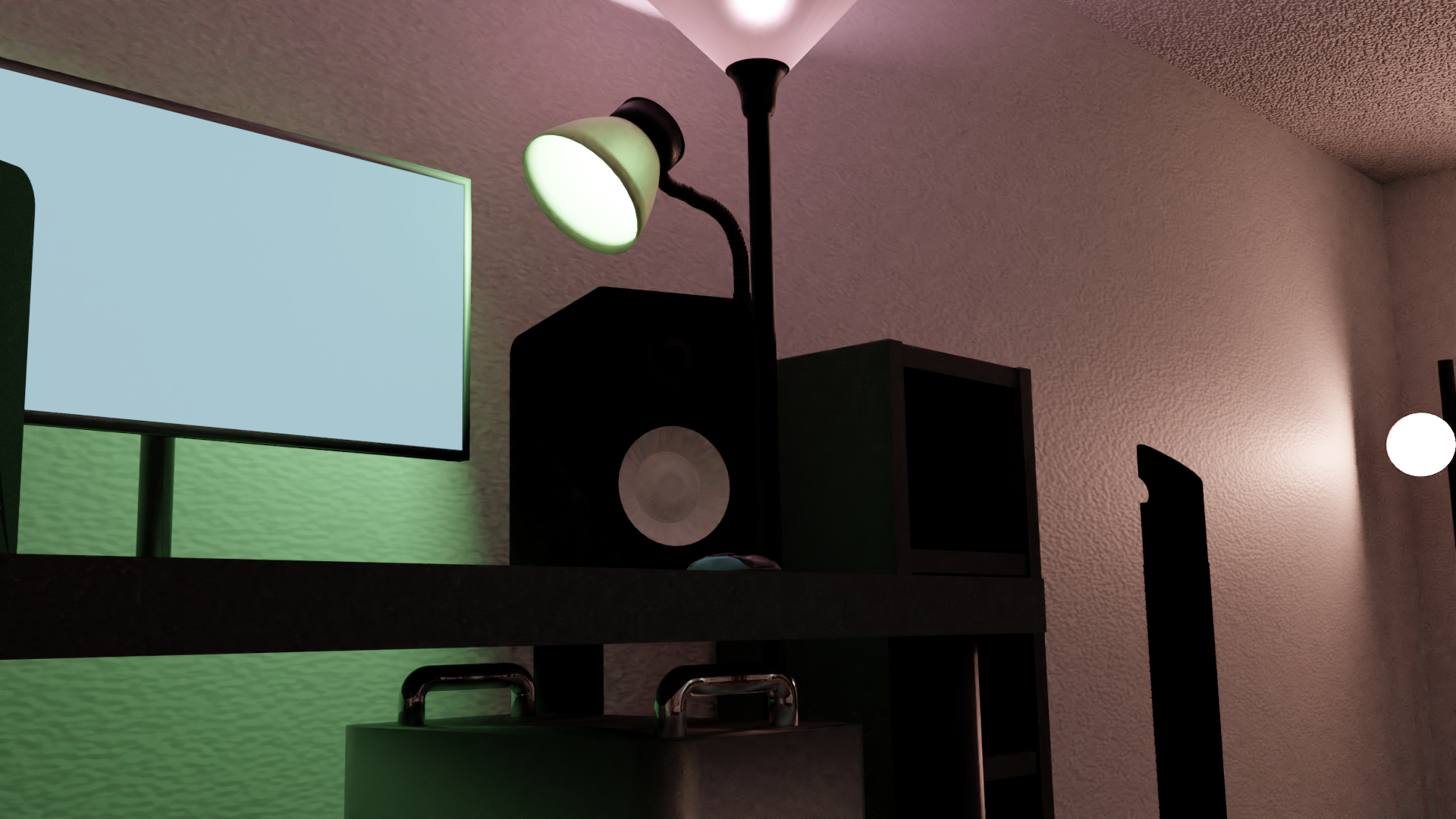
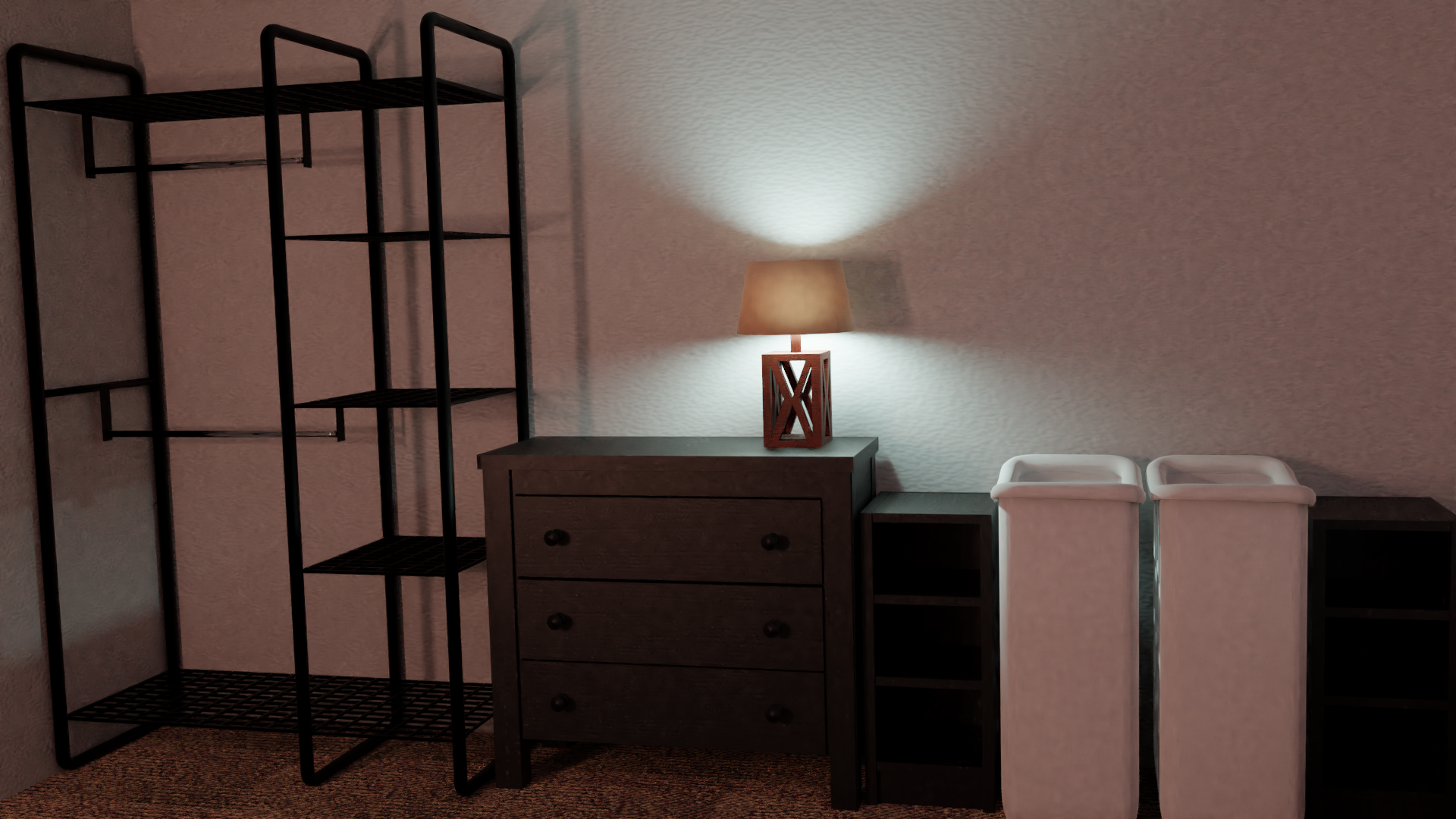
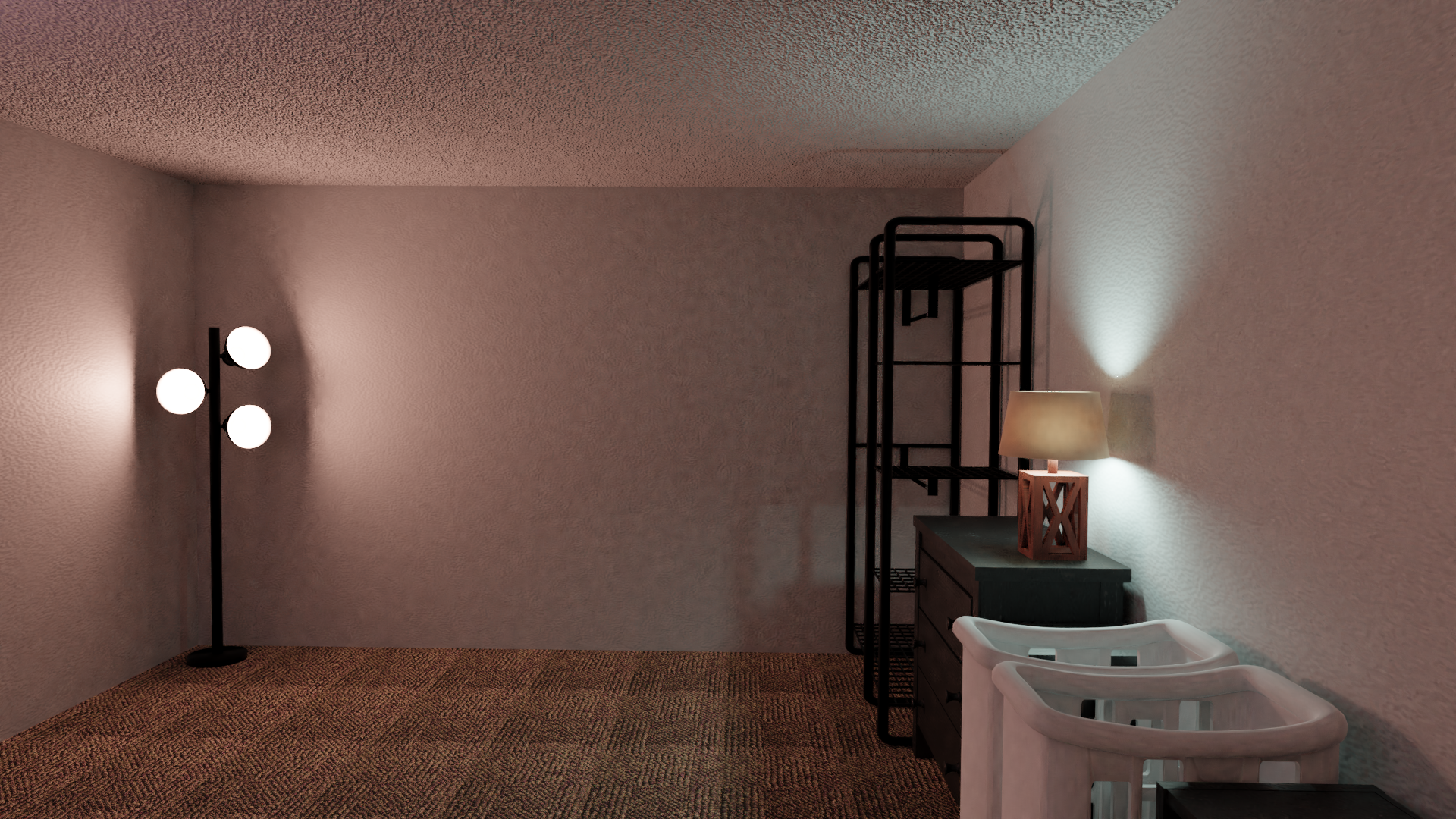
Renders have de-noising applied to them, which is why they look a little weird
What I did this week (Jan 25, 2021 - Feb 1, 2021)
After spending last week focusing on Unity tutorials and the basics of game design in that engine, this week I determined that the rest of my learning curve involved custom assets made in Blender, the workflow of moving back and forth between programs, and then adding interactivity to those assets so that they would fill in the rest of the learning curve gaps. Rather than go ahead with making my final project, and potentially risking messing up the file or even writing poor code in it, I decided that I should spend a bit of time modelling a smaller prototype map to cover baking textures, animations, lights, and normals, along with bendable objects, manipulable objects (like drawers), interactive objects, and scaling to a player size. All of these concepts are applicable to my real-life bedroom. My computer is interactable and can play files. I have a desk lamp that can move and create a dynamic, moving light source. I have wooden desks and shelves that need image textures and normal maps that I have to bake. I have a fan that rotates back and forth, and thus requires an animation. So, I spent the week modelling my bedroom in blender to use as a test map for all of these concepts. Along with that, I decided to livestream portions of my modelling, both to make the process more exciting for myself and to produce documentation of it. Also, it lets anybody who might be interested in the creation of this project, which might have some sort of payoff when it is completed, or at least begins to open it to a wider audience beyond EDP. Along with off-camera work, I did two livestreams around 2 hours each.
Reflections on the Week
Progress is a little slower than I would like. I still have texturing work to do on the room, but I want to really get going on the true final project next week, and not get too hung up on this prototype room which is just that, a prototype, a testing ground that can be damaged and inefficient. Of course, I expected the first few weeks of the class to involve a lot of time spent learning and testing on smaller scale work, just because I have never used Unity before. However, I also have something that is not really capable of providing much in a critique setting, as it is a completely different environment than what my final project will be. It will definitely provide me with a lot of feedback on how to get systems working, and trials of the potential those systems might have for artistic impact, but I feel like that is my learning process in creating it, and not something that can really be improved on in many ways through critique. Looking back on it, perhaps I should have made a small chapel so that at least I’m working with religious iconography and possibly producing assets (like crucifixes or candles or hymnals) which could be imported into the final project. However, there would be no point in doing that now considering how much of the room I have already made. Still though, next time I should have my smaller prototype project be something more relevant so that it pushes a bit of progress toward the real final beyond code that I intend to copy and apply to an entirely different object.
Long story short, I definitely should work on a smaller version of the final artifact next time, instead of something independent, and I feel like I need to do catch up work in this next week to get back on pace.
This week’s Inspirations
One film I watched this week that got me thinking about my capstone was Frederico Fellini’s And the Ship Sails On (1983). While having almost nothing to do with the themes of my capstone, Fellini’s films follow a structure that is actually similar. Rather than provide a clear narrative arc, Fellini chooses to offer a collection of seemingly disconnected scenes with the same few characters and locales, which has the effect of building a world the viewer inhabits and builds ideas off of. In And The Ship Sails On he does this with a group of 1914 European bourgeois aristocrats on a ship sailing to an island to spread the ashes of a great singer who passed away. Meanwhile, given the year it takes place, World War I is slowly breaking out as the people on the ship continue their indulgences relatively unaffected or unaware. All of the ideas of the film come from self-contained scenes that highlight a sort absurdity in the minds of the people on board, whose perspective the film clearly favors to highlight that absurdity. Examining the successful disconnected structure of Fellini’s film, which is a deeply impactful despite seemingly lacking a main plot prompts ideas in my mind about how to go about exploring these various sound environments that clue the player into the life of the person they inhabit. It seems like having a central point to be made through the perspective of the memory is a way to carry a thematic through-line, or a couple, from memory to memory. Here’s a clip a liked from the film where these composers play a beautiful, almost impossible song on glasses, and the whole kitchen staff is amazed at their prowess. You’ll see what I mean when I say it is hyper-real or absurdist.
On top of that film, I also have been trying to find small-scale independent VR art games. Unfortunately, simply Googling VR Art Games returns a bunch of creative tools, like Tiltbrush, which allow users to create beautiful things in 3D space, but are not what I’m looking for. In his essay Stranger Playthings Paolo Pedercini writes about this exact problem, as he divides VR into expansions of cinema, simulations, communication devices, and the “less popular tendency of VR” the augmentation of dreams. Funnily enough, he immediately follows this up by talking about the architecture of churches saying, “They used using illusionist techniques to blend 2d images with architecture and provided a truly immersive experience, including the play of light (candles, stained glass), and smell (incense, which highlights light beams like a fog machines), surround sound…” While not really providing any examples of contemporary VR artists hosting work on platforms like Steam, he does include some early pioneer artists in the first wave of VR, when the headsets were clunky and hardly functional. These include: Jaron Lanier, Dancing with the Virtual Dervish, Placeholder, and Char Davies, all artists I intend to explore further in the coming days. For now, let’s focus on one guy…
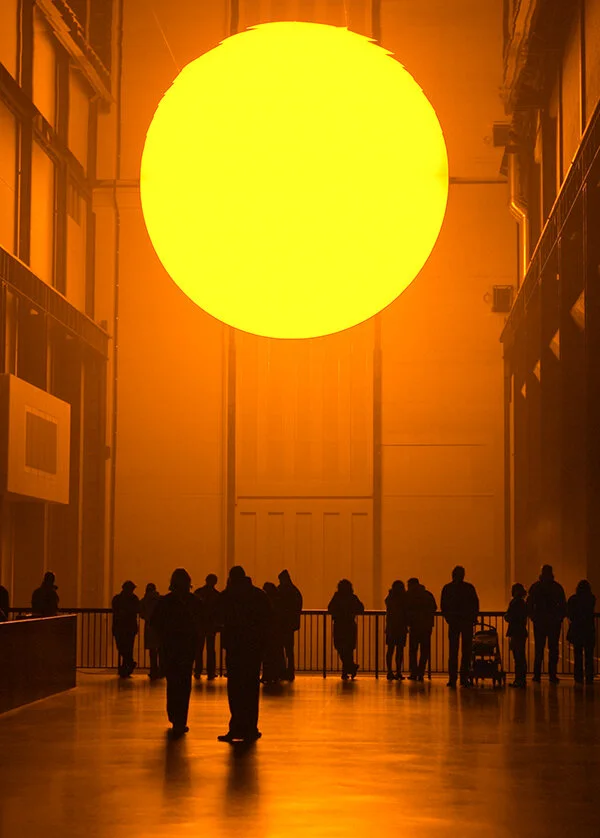
The Weather Project Olafur Eliasson (2003)
Artist Profile
This week, I want to focus on an artist who creates immersive spaces in real life, and whose work I have had the pleasure of seeing in person: Olafur Eliasson. Eliasson is a Danish-Icelandic artist who works in a lot of different fields, but specializes in simple, effective, immersive spaces in galleries. For example, he will have a room that is filled with fog and colored lights, where you can’t see beyond 4 feet in front of you, and the having the art experience live in the sensory deprivation that occurs. Another example is a room that is pitch dark, with a camera flash going off periodically, pointed at a fountain. Thus, all you see is these snapshots of water forms that don’t move. Beyond that, his work can be something as simple as a fountain that goes over a window to make it look like it is raining outside.
One of my favorite projects of his is The Weather Project which installed a giant sunlight in the Turbine Hall (which is the main lobby) of the Tate Modern in London. The official Tate website describes it saying,
“In this installation, The Weather Project, representations of the sun and sky dominate the expanse of the Turbine Hall. A fine mist permeates the space, as if creeping in from the environment outside. Throughout the day, the mist accumulates into faint, cloud-like formations, before dissipating across the space. A glance overhead, to see where the mist might escape, reveals that the ceiling of the Turbine Hall has disappeared, replaced by a reflection of the space below. At the far end of the hall is a giant semi-circular form made up of hundreds of mono-frequency lamps. The arc repeated in the mirror overhead produces a sphere of dazzling radiance linking the real space with the reflection.”
While I saw a different exhibition of his at the Tate, imagining the work filling a space like the Turbine Hall (which is like 6 stories high) is truly a remarkable thing to think about. Much of my concern and interest in creating VR artwork is control over environment and the sense of scale VR offers. While the pictures of Eliasson’s work are stunning, they are only a fraction of what it must have been like to actually witness it. Physical immersive artworks like this, however, are temporary. They get taken down eventually, and photos that don’t quite do it justice are what we’re left with. VR artworks, as long as they are kept up to work on modern machines, theoretically can be a more permanent installation.
Eliasson also has interesting thoughts on how The Weather Project was to be exhibited and marketed, all of which focus on making the art experience both as genuine as possible, in other words free from influence of curator editorializing via signage, and as transparent as possible, in that he intentionally allowed some of the technology to show to remind viewers of the constructed nature of the work, giving them enough distance to carry thoughts on it into their lives after experiencing it. Recently I have also been thinking about how I want the area and “marketing” around my capstone to be. While not feasible, I thought about setting it up in a parking garage so that the overpowering nature of the cathedral idea contrasts harshly with the users real life surroundings. Furthermore, I have been thinking about focusing more on that choice to remove the headset, and exit the experience, as a part of it, and what I can do to capitalize on that choice as a meaningful aspect of the work.